Why The New Ocean Alliances Mean You Should Renegotiate
On April 1st, 2017 ocean shipping got bigger by getting smaller. After a tumultuous 2016 that saw rates bottom out, capacity issues, and bankruptcy for of one of the world's largest carriers (Hanjin), we were bound to reach a tipping point. With only a quarter until the new shipping alliances were set to take affect it looked as if the seas were swelling towards this perfect storm. Fortunately, that didn't quite happen. Through a series of mergers, acquisitions, and realignments the industry appears to have righted a course that once looked charted for disaster. With this new direction it is imperative that you reevaluate your ocean carriers to ensure these new alliances have left your supply chain in the best position possible. Read on to learn about the new alliances and what it means to you the shipper.
What is an Ocean Carrier Shipping Alliance?
In its most simple form an ocean carrier shipping alliance is a group of carriers that share vessel space with one another. They do so with cooperative agreements that extend across trade lanes while increasing each carrier member's global reach. What that means is you could have a contract with CMA CGM and your shipments could be sailing under their bill of lading while actually arriving at port on a COSCO vessel and vice versa.
Since operational costs and bunker fees comprise the bulk of each carrier's spend, alliances also serve to maximize profitability and minimize risk. As a new generation of 14,000 TEU mega ships take to the water, it is important to the carriers that they move at capacity. By sharing space with members, the alliance is better able to fill each vessel.
What the alliance may not do is fix rates among carrier members or share customer information. Doing so is a serious offense and has been investigated before.
Who are the new alliances?
-
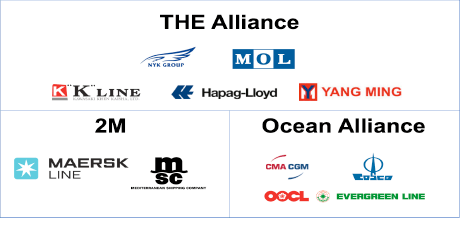
Ocean Alliance: CMA CGM, COSCO, Evergreen, APL, and OOCL (OOCL is being purchased by COSCO, APL is now owned by CMA CGM)
-
THE Alliance: NYK Line, K Line, MOL, Hapag Lloyd, Yang Ming ( NYK, K Line, and MOL are merging in 2018 to form ONE)
-
2M Alliance: Maersk, MSC
What do they cover?
Combined, the three alliances represent 77.2% of global container capacity and eclipse all non-alliance carriers with 96% of all East-Weat trade lanes.
If you're moving any ocean freight, it is nearly impossible to avoid using an alliance carrier.
5 Things you should you know when negotiating service contracts
When deciding on which carriers to work with you'll need to make sure they provide adequate coverage for your specific lanes. It may require using one or more carriers to get the best rates and service for your port routing. With the new alliance groupings this may mean reevaluating who you've used in the past and working with carriers who belong to a better positioned network.
-
Routes : Review your current carriers and make sure that they're currently offering service to all of the ports to which you require service. If your current cast of carriers run routes across multiple alliances it may be time to consider realigning with carriers within the same alliance or to futher diversify your alliance network.
-
Space : What is the capacity of each carrier and their alliance along your key routes? If you're negotiating with CMA CGM they may be using a vessel operated by COSCO. It's important to note that even though these carriers are in an alliance together, the vessel operator has first right of refusal. This may be an issue during peak season when space is limited.
-
Flexibility : Just because a carrier is in an alliance doesn't mean that they will always have access to every vessel within the alliance. Each carrier has a finite amount of space on each vessel and there are limitations placed on where and when they can book space. For this reason you may need to work with carriers across alliances to ensure that you don't experience any gaps in service.
-
Positioning : If your volume is consistent across a lane take note of who the vessel operator is. If your contract is with a carrier who isn't operating the vessel then it may be time to talk to sales reps at the vessel operator. Since the operator has first right of refusal, it very well could be in your best interest to give them a weekly or monthly volume agreement. This can help mitigate any issues with your cargo getting rolled when capacity becomes a concern.
-
Rates : While rates are driven by the market it is important to negotiate any future increases and GRIs (general rate increases) that could raise your shipping costs down the line. Each carrier
operates slightly differently and being a part of an alliance doesn't mean that rates are tariffed across the board. Leverage your volume to reduce or remove future fees. When doing so, keep in mind that a better rate doesn't always mean better service and while you may save money up front, you could be putting your cargo at risk by assigning lanes to carriers who may not be in the best position to handle it come peak season.
So far 2017 has been a year of turn around for the ocean freight industry. Rates are seeing more stability, larger ships are hitting US ports, schedules are getting back on track, and carriers are gaining a better outlook on their futures. With this sense of clarity, shippers should have a renewed sense of confidence when negotiating their ocean freight contracts for the rest of 2017 and 2018. Now would be a great time to audit your services, review your lanes, benchmark your carriers, and ensure that your freight is properly routed. Contact Aborn today for a free consultation.